Last-mile delivery is the final leg from a fulfillment centre to your customer’s door. It’s the most expensive part of shipping. Here’s why it costs so much, how city and rural routes differ in Canada, and what to ask a last-mile carrier before you sign.
The shortest leg of a parcel trip is the most expensive one. The Capgemini Research Institute’s last-mile delivery study put the cost of that final leg at 41% of total supply chain costs. It costs more than warehousing, sorting and packing, and found that retailers recover only about 80% of what delivery costs them.
That gap comes straight out of your margins. Every failed attempt, every slow rural route, and every “where is my order” email adds to a cost you can’t fully pass on. So, the way you set up the last mile decides how much of each sale you keep.
This guide explains what last-mile delivery is, why it costs so much, how last-mile delivery in Canada differs between cities and everywhere else, how to compare last-mile carriers, and what to ask before you sign.
What Is Last-Mile Delivery?
Last-mile delivery, also called final-mile delivery, is the last leg of a parcel journey. It is from a local depot or fulfillment centre to the customer’s door. It’s the shortest distance a parcel travels, and the one your customer sees.
Until then, parcels travel in bulk. One trailer can carry thousands between hubs in a single run. The last mile breaks that load into single stops, and each one adds an address to find, a door to get through and a chance for something to go wrong.
Why the Last Mile Costs So Much
Three things drive the bill:
- Stop density. A van in a dense neighbourhood can make many stops close together. The same van on a rural route spends most of its day driving between them, so the cost per parcel climbs fast as density drops.
- Failed attempts. A locked lobby, a missing buzzer code, or an empty house sends the parcel back to the van. The re-delivery costs as much as the first try and delays the customer.
- Customer contact. When tracking is unclear, customers ask where their order is, and each question costs support time. Clear tracking and proof at the door prevent most of them.
Those three costs add up and may keep rising. More than 90% of European logistics leaders in a 2025 FarEye survey, summarized by Locus, rank the rising cost of delivering each parcel. These costs are driven by labour, fuel and failed attempts, among their top three last-mile challenges. Shoppers won’t absorb the increase either. In Capgemini’s research, as Supermarket News reported, just 1% said they’d pay the full cost of delivery themselves.
How Last-Mile Delivery in Canada Differs in Cities and Rural Areas
Canadian online sales are still growing into their share. Statistics Canada’s March 2026 retail release put e-commerce at 7.1% of retail trade, and most of those parcels go to a handful of metro areas.
In Toronto, Montreal, Vancouver and Calgary, density keeps costs down, but access gets harder. High-rise towers mean fob-controlled lobbies, elevator waits, and crowded parcel rooms. So, a carrier that knows the buildings and can leave a parcel securely beats one that only knows the streets.
Outside those cities, the maths flips. Long gaps between stops push costs up, and national carriers often add surcharges for remote postal codes. Most brands end up with two answers: a local carrier with its own drivers where order volume is dense, and a national network everywhere else.
How to Choose a Last-Mile Carrier
No single last-mile carrier suits every route, so most brands use more than one. Here’s how the three main types compare:
| Carrier type | Best for | Trade-off |
| Local or regional carrier with its own fleet | Dense metro areas; same-day and next-day | Coverage stops at the edge of its routes |
| National carrier | Rural and remote postal codes | Higher surcharges and earlier cut-offs |
| Crowdsourced drivers | Short spikes and on-demand delivery | Less consistent tracking and handling |
Before you sign with any last-mile carrier, ask four things:
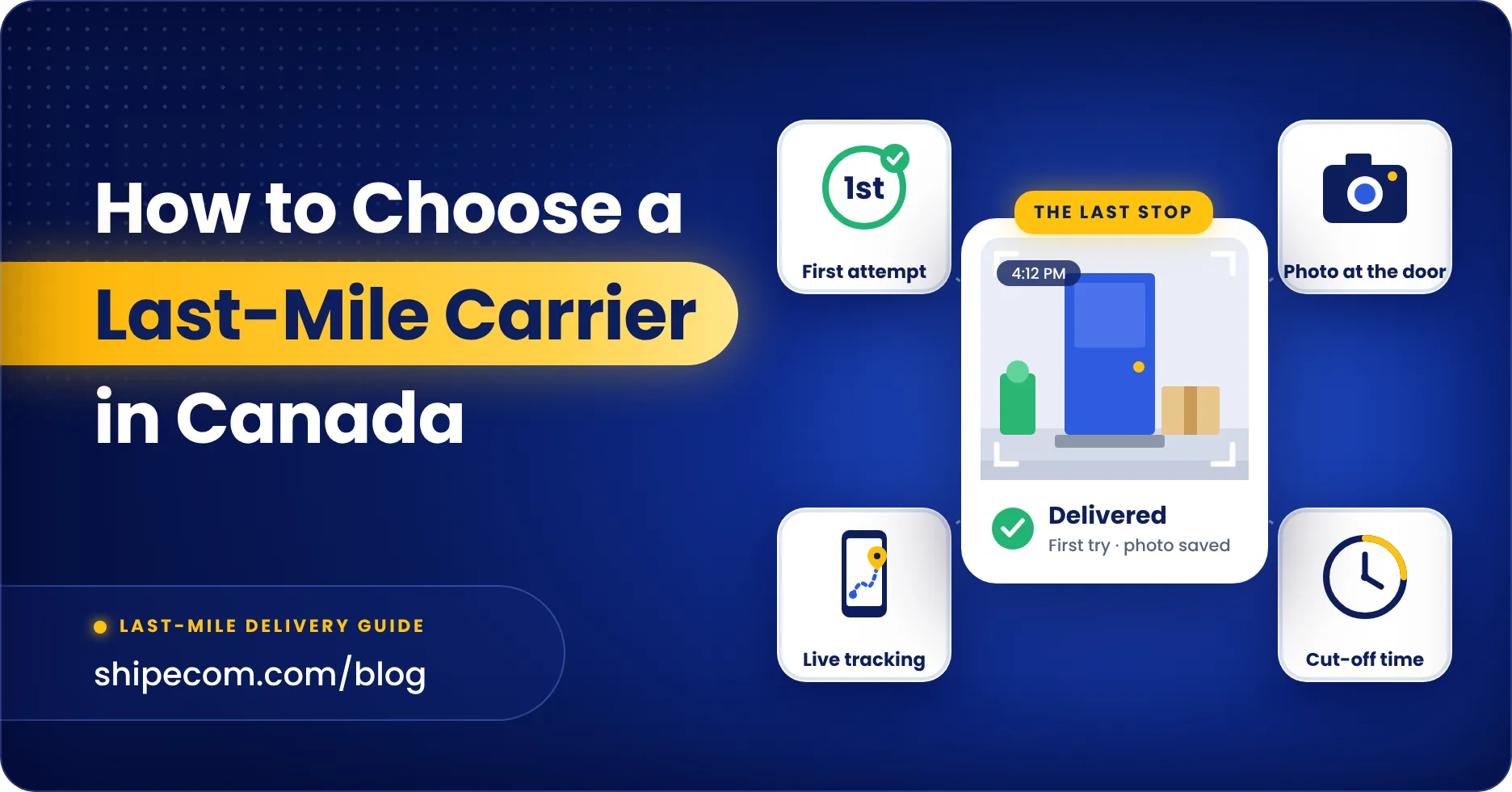
- What’s your first-attempt delivery rate, and how do you measure it? Failed attempts are the hidden cost, so get the number in writing.
- What proof do you capture at the door? A timestamped photo on the order record settles most disputes before they reach your inbox.
- Can your tracking events feed my store and emails in real time? Delayed scans create “where is my order” tickets.
- What’s your latest pickup for next-day delivery? A later cut-off gives your warehouse more of the day to ship.
Labels matter at the handoff, too. Carriers and retail distribution centres scan barcodes to route parcels and GS1 Canada’s barcode guide sets out the standard most of them read.
What Canadian Shoppers Expect at the Door
Whichever carriers you choose, shoppers judge the delivery as part of your brand, and the research shows how much it affects whether they buy again:
- DHL’s 2025 Canada e-commerce report found 3 in 4 Canadian shoppers won’t buy from an online retailer if they don’t trust its delivery or returns provider. 48% say long delivery times frustrate them.
- Canada Post’s ecommerce research found 40% of Canadian online shoppers have avoided buying again after a brand did a poor job managing delivery timing.
- Baymard Institute’s checkout research shows 20% of US shoppers who abandoned a checkout left because delivery was too slow.
The Canadian figures describe what shoppers say rather than what they did, but they match the US checkout data. A slow or unreliable delivery promise costs you the order.
How Ecom Runs the Last Mile
We run last-mile delivery on our own vans in the markets where we have routes, so one team handles the parcel from our fulfillment centre to the door. Our network includes 500+ vehicles, reaches 65% of Canadian households and delivers at a 98.3% on-time rate. Every completed delivery on our routes carries a timestamped photo on the order record, with live tracking along the way.
For brands on Shopify, Ecom Now adds same-day delivery at checkout. Customers order eligible products before noon and receive them by 9 PM. Next-day and two-to-seven-day standard options cover the rest of the country.
“The cheapest delivery is the one that only happens once. When the driver knows the building and the photo lands on the order, the parcel gets delivered first time and the customer never has to ask where it is.” Says Yash Chojar, Sr. Director, Last-Mile Delivery at Ecom.
Building a Last-Mile Delivery Setup That Fits Your Orders
The right setup starts with your own order data. Look at which postal codes receive most of your parcels and give those routes to a carrier with its own drivers. A national network can cover the remote addresses that see fewer orders. Whichever carriers you use, measure them on the same three things: delivering first time, tracking in real time and leaving proof at the door.
If you want to see what that looks like for your volumes, our team can review your delivery data and map the routes we’d run.
Frequently Asked Questions
Quick answers to the questions brands ask most about last-mile delivery in Canada.
1. What is last-mile delivery?
Last-mile delivery is the only part of shipping your customer sees: the parcel leaves a local hub on a van or courier route and ends up in their hands, on their doorstep or in a parcel locker. Carriers and 3PLs also call it final-mile delivery.
2. Why is last-mile delivery so expensive?
Earlier legs move thousands of parcels in one trip, but the last mile needs a separate stop for every parcel. Capgemini’s research puts it at 41% of total supply chain costs, and sparse rural routes, failed attempts and customer questions all push that share higher.
3. How do I choose a last-mile carrier in Canada?
Match the carrier to the route. Use a local carrier with its own drivers where your orders are dense, and a national network for rural and remote addresses.
4. Does Ecom deliver outside major cities?
Yes. Our own vans cover the markets where we run routes, and we book other carriers for the rest of Canada, with next-day and standard options.