
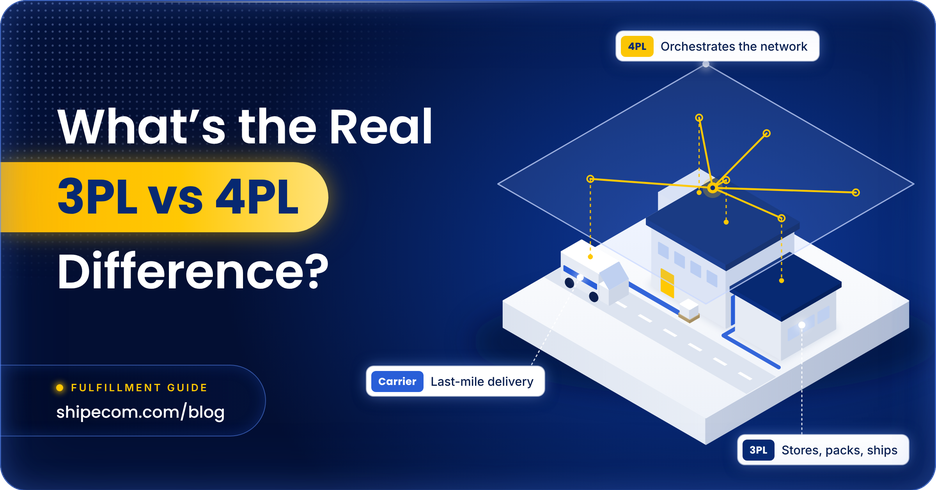
The difference between 3PL and 4PL comes down to who does the work and who manages it. Here’s what each model covers, what it costs you in fees and control, and how to tell which one your brand needs.
Your orders doubled this year. The spare room is full of boxes, your team spends afternoons packing instead of selling, and a retail buyer just asked who handles your logistics. One advisor tells you to find a 3PL. Another says you need a 4PL.
Pick the wrong model and you either pay a management fee you don’t need or end up chasing partners yourself. There is also a third option for many brands to miss: an integrated 3PL that runs warehousing, freight and delivery under one team, so you get one point of accountability without the extra management layer.
This guide covers third-party vs fourth-party logistics: what each model does, how they differ on cost and control, and when to use a 4PL vs 3PL.
Key Takeaways
- A 3PL does the hands-on work (storage, pick and pack, shipping, returns). A 4PL manages the partners who do that work.
- 4PL logistics providers charge a management fee or gainshare on top of partner costs, which pays off mainly at large, multi-region scale.
- Most ecommerce brands shipping from one to three warehouses are better served by a 3PL, especially an integrated one that also handles freight and last-mile delivery.
What Does “PL” Mean in Logistics?
“PL” stands for party logistics. The four levels are based on how much of your logistics you hand to outside companies:
- 1PL (first-party logistics): You do all the work, moving your own goods with your own staff, warehouse and vehicles.
- 2PL (second-party logistics): You hire a carrier, such as a trucking company, airline or shipping line, to move your inventory from one point to another. The carrier transports your stock but doesn’t manage it.
- 3PL (third-party logistics): An outside provider, such as Ecom Logistics, handles your storage, fulfillment and shipping.
- 4PL (fourth-party logistics): An outside company manages your whole supply chain, including the 3PLs and carriers.
For most ecommerce brands, the real choice is between the last two.
What Is a 3PL?
A third-party logistics provider handle the hands-on jobs in a warehouse. That covers:
- Receiving inbound inventory and checking it against your advance ship notice
- Storing stock and cycle-counting it so your store shows real numbers
- Picking, packing and labelling orders
- Shipping through parcel carriers, freight partners or its own delivery fleet
- Processing returns and putting stock back on the shelf
You still decide where your stock sits, and the 3PL reports on order of accuracy and stock levels.
Most 3PLs own or lease the assets they use in warehouses, racking, scanners, and sometimes vans or trucks. At Ecom, we have 450,000 sq ft of warehouse space across Toronto, Vancouver, Philadelphia, Dallas and LA, plus last-mile hubs in Canada.
What Is a 4PL?
A 4PL, or fourth-party logistics provider, manages your entire supply chain on your behalf, including the 3PLs, freight forwarders and carriers that move your goods.
A 4PL:
- Designs your logistics network: the number of warehouses, where they sit and the carriers that serve them
- Selects, contracts and manages 3PLs, freight forwarders and carriers for you
- Runs a control tower or software layer that pulls data from different partners into one view
- Owns performance across the whole chain and settles problems between partners
A pure 4PL does not own warehouses or trucks. It sells coordination: you sign one contract, and the 4PL deals with everyone else.
The term dates to 1996, when Accenture, then known as Andersen Consulting, registered “fourth-party logistics” as a trademark and described a 4PL as a supply chain integrator that combines its own resources with those of complementary providers. The trademark is no longer registered, so anyone can use the label now.
3PL vs 4PL at a glance
| 3PL | 4PL | |
| Main job | Executes storage, fulfillment and shipping | Plans and manages the whole supply chain |
| Assets | Owns or leases warehouses, equipment, sometimes vehicles | Often asset-light; uses other companies’ assets |
| Who you manage | The 3PL | The 4PL, which manages everyone else |
| Scope | One or several functions | End to end, often across regions |
| Strategy | You set it | The 4PL recommends and often decides |
| Pricing | Fees per pallet, pick, order and shipment | Management fee or gainshare on top of partner costs |
| Typical client | Growing ecommerce and B2B brands | Large, multi-region operations with many partners |
The Thin Line Between 3PL and 4PL
Many 3PLs now offer services that used to belong to 4PLs, such as freight booking, cross-border coordination, and network advice. Some software firms even brand themselves as 4PLs without moving any freight.
Picture a missed delivery. If you end up calling the carrier yourself, your 3PL stops at the door. If the provider calls the carrier, fixes the problem and reports back to you, you are getting the accountability a 4PL sells.
Integrated 3PLs sit in the middle ground. At Ecom, we run fulfillment, freight and last-mile delivery ourselves, so the handoff between the warehouse and the doorstep stays within our team. Many brands prefer this single point of accountability, and they skip the extra management fee.
Most of our brands do not need another layer of management; they need fewer handoffs. Every problem has one owner when one team stores the inventory, packs the order, and delivers it.
– Omar Laz, Senior Director of Fulfillment.
When a 3PL Is the Right Choice
A 3PL may suit you if:
- You ship from one to three warehouses, or want to start with one
- Your logistics team, even if it is only one person, can manage a few partners
- You still want a say in inventory placement, packaging and carrier choice
- Your order volume is climbing, and you need capacity before peak, without signing a warehouse lease
- You sell D2C, wholesale and on Amazon, and want one inventory pool for all three
Most ecommerce brands ship a few hundred to tens of thousands of orders a month to land here. That group keeps getting bigger: Statistics Canada counted $5.6 billion in Canadian etail e-commerce sales in August 2026 alone, 7.6% of all retail trade.
When a 4PL is the Better Choice
A 4PL is the better choice when your team is stretching thin coordinating partners instead of running the business. You have reached that point if:
- You manage several 3PLs, freight forwarders and carriers across countries at once
- Nobody tracks inventory and landed costs in one place
- Partners blame each other when something goes wrong, and you lose days and profit sorting it out
- You want your whole network redesigned, with one company accountable for everything
Manufacturers with global sourcing, multinational retailers and companies with complex inbound supply chains use 4PLs most. A company shipping parcels from one or two warehouses usually doesn’t need one yet.
What You Pay, and What You Give Up
With a 3PL, you pay for receiving, storing, picking, packing, and delivering your orders. Each activity is itemised on your invoice, so you can see how much one order costs you. Ecommerce Fulfillment Costs digs deeper into how picking, packing and storage charges add up, and where hidden costs creep in.
A 4PL adds another cost: a management fee on top of what its partners charge. Some 4PLs structure it as gainshare and take a cut of the savings they find. A 4PL renegotiating carrier rates across millions of shipments can save you more than its fee. A brand shipping a few thousand parcels a month lack that buying power, so the fee becomes overhead.
You also trade away some control. A 4PL makes many of the calls a 3PL would leave with you, so you save time but sit a step further from your carriers and your data.
Questions Worth Asking
Ask these questions of any provider you are considering, and compare the answers:
- Which services do you run yourselves and which do you subcontract?
- Who do I call when a shipment goes wrong between two of your partners?
- Can I see inventory, orders and tracking in one place, as they change?
- How do you charge, and what would last month’s invoice look like at my volume?
- What happens to my stock and my data if I leave?
- Which accuracy and on-time numbers do you report, and how do you measure them?
Send your last three months of order data along with the questions and see which providers price against your volumes and destinations. In the 2026 Annual Third-Party Logistics Study, 90% of shippers listed IT capabilities as important when choosing a 3PL. However, only 57% were satisfied with what the provider delivered.
Our choosing the Right Ecommerce Fulfillment Partner in Canada post has a full list of questions to put to any provider.
One Team from Shelf to Door
Start with what’s slowing you down. If you need warehouse space, trained staff, and faster shipping, a 3PL solves it. If you already juggle several logistics partners and nobody coordinates them, a 4PL may be worth the fee.
For most growing brands, the answer sits between one provider that runs the work and owns the result. That’s what we built Ecom to do.
Talk to an Ecom Fulfillment Expert
Frequently Asked Questions
1. What is the difference between 3PL and 4PL in simple terms?
A 3PL does the logistics work: storing, packing and shipping. A 4PL manages the logistics, including the 3PLs and carriers doing that work.
2. Is a 4PL better than a 3PL?
It depends on how many partners you run. A 4PL fits large supply chains spread across regions. Most ecommerce and B2B brands get more from a 3PL, because they want capacity and want to keep control of their inventory and delivery promise.
3. What is 5PL?
A 5PL is usually described as a step beyond a 4PL: it pools the shipping volume of many clients to negotiate carrier rates and runs their logistics networks largely through software. For most ecommerce brands, the 3PL vs 4PL choice matters far more.
4. Should a small ecommerce brand use a 4PL?
Not while you ship from one or two locations. At that size, you’d be paying a 4PL to coordinate partners you can manage yourself. A 3PL with good integrations and clear reporting covers you.
5. Does Ecom Logistics offer 3PL services in Canada and the United States?
Yes. Ecom Logistics provides ecommerce fulfillment, freight and last-mile delivery from fulfillment centres in Toronto, Vancouver, Philadelphia, Dallas and LA. Contact us (add link) to discuss your products, volumes and markets.
Choosing Between a 3PL and a 4PL with Ecom
Look at what is slowing you down today. If you need warehouse space and faster shipping, a 3PL handles it. If you already have several logistics partners and nobody coordinating them, a 4PL might be worth the fee.
Selling in Canada and the US and want fulfillment, freight and same-day or next-day delivery under one team?