
Same-day delivery is usually sold as a race against the clock. The research points somewhere more useful. Here is what gives a same-day promise its commercial value, and why we built Ecom Now around keeping it.
A shopper finds the product. The price works. It is in stock. Then, before they commit, they look for one more answer: when will it arrive?
That question now sits inside the buying decision. For ecommerce brands, the answer can decide whether the order lands on their own storefront or a competitor’s.
Speed helps a brand win that moment. But the evidence shows that what brings the customer back is harder to copy: a delivery promise they can trust, kept every single time.
This blog looks at what the research says about delivery, buying decisions and loyalty, where same-day delivery earns its place, and what it takes to offer it without breaking the promise.
The Sale Isn’t Over at “Add to Cart”
Brands spend heavily on getting a shopper to the checkout. Delivery is one of the last things that can still send them away.
Delivery is now part of the price of the product
Shoppers judge the whole offer: the product, the price, when it will arrive and what it costs to get delivered. When any one of those falls short, the order is at risk.
The Baymard Institute’s checkout research shows how often that happens:
- 20% of shoppers who abandoned a checkout did so because delivery was too slow
- 40% left because extra costs, including shipping, were too high
- Across 50 studies, the average documented cart abandonment rate sits at 70.22%
Slow delivery ranks as the second most common reason for consumers walking away, ahead of trust concerns, forced account creation and complicated checkouts.
Why this matters more every quarter
More of the buying decision now happens on a screen, where the delivery promise is part of the offer.
- United States: ecommerce reached $340.2 billion in Q2 2026, 17.1% of all retail sales and up 12.2% year over year
- Canada: ecommerce sales reached $5.73 billion in June 2026, 7.7% of total retail sales
Every point of that growth is another order where delivery helps decide the purchase outcome.
A promise only sells if shoppers see it in time
A delivery option that only appears at the final step can’t help sell the product. By then, the shopper has already weighed the offer.
Baymard’s benchmark found that 41% of ecommerce sites don’t show an estimated delivery date when shoppers choose a shipping method. Many brands are leaving their delivery promise out of the purchase decision entirely.
When a shopper can see on the product page that an item arrives today, the promise starts working as a reason to buy.
Does Faster Delivery Actually Sell More?
It’s the question every brand asks before investing in speed, and peer-reviewed research offers a clear signal.
Same-day is already moving sales at scale
In August 2026, Amazon told sellers in its fulfillment program that products offered with its fastest delivery option, arriving in two hours or less, saw 12% higher sales on average than with standard delivery, as reported by Shopifreaks.
Shopper behaviour is moving the same way. In 2025, according to Amazon:
- US Prime members received more than 8 billion items the same or next day, up more than 30% from the year before
- Items delivered in less than a day rose 70% year over year
- The average number of monthly same-day customers in rural areas nearly doubled
Amazon says members are using fast, free delivery “to order meaningfully more often.”
Customers who get fast delivery spend more
CIRP estimates that Prime members spent $1,170 at Amazon.com in 2024, compared with $570 for non-Prime customers. Prime includes more than shipping, but fast, free delivery sits at its core, and the customers who have it spend about twice as much.
One day faster, 13.3% more sales
A 2023 study in Manufacturing & Service Operations Management, one of the leading operations research journals, examined delivery performance on a large ecommerce platform. Researchers Vinayak Deshpande and Pradeep Pendem estimated that cutting three-day deliveries to two days would raise average daily sales for third-party sellers by 13.3%.
The effect was strongest for sellers with a larger share of slower orders and a higher spend per order.
Why the effect compounds
The study traced how the lift happens. Delivery performance shapes the logistics ratings customers leave. Those ratings shape whether the next shopper buys.
In other words, today’s delivery is part of tomorrow’s sales pitch. Every order that arrives as promised quietly persuades the customers who come after it.
What this does (and doesn’t) tell us
The study measured a move from three days to two, on a single large marketplace. It doesn’t predict what same-day delivery will do for any individual brand. What it does establish is the direction: delivery speed and delivery performance are genuine drivers of purchase decisions, with a measurable effect on revenue.
Same-Day Isn’t for Every Order. That’s Exactly Why It Works.
The weakest case for same-day delivery is that every customer wants everything today. The research says they don’t, and that’s good news for brands.
Most shoppers will wait. Some won’t.
McKinsey’s 2025 survey of more than 1,000 US consumers found that:
- About 90% are willing to wait two or three days, especially to avoid shipping costs
- Speed ranked as consumers’ top delivery priority in 2022 and fell to fifth in 2024, with cost moving to the top
- Fewer than 5% choose the fastest option regardless of price
Read quickly, that sounds like a case against same-day. Read carefully, it describes a market with two kinds of moments: the many orders where a shopper is happy to wait, and the smaller, high-intent orders where waiting means shopping somewhere else.
The moments where today matters
Some purchases come with a deadline the shopper didn’t choose:
- A gift for an event tonight
- A replacement for something that broke this morning
- An outfit, a charger, a supply they forgot until the last minute
- A product they’ve been considering, where “today” is the nudge that closes the decision
In these moments, a same-day option can turn a maybe into a yes. Without one, the order often goes to whichever retailer can deliver today.
Choice is the real upgrade
McKinsey also found that more than half of consumers value being able to schedule deliveries, rising to about 70% among urban shoppers. Shoppers want control over how their order fits their day.
A same-day option adds to that control. It sits beside standard and next-day delivery, so each customer can pick the promise that fits the purchase.
| Shopper moment | What they value most | Option that fits |
| Restocking an everyday item | Lowest cost | Standard delivery |
| Planned purchase, no rush | Free or low-cost shipping, a reliable date | Standard or next-day delivery |
| Needs it for tomorrow | A dependable date | Next-day delivery |
| Needs it today, or wants it now | Certainty it arrives tonight | Same-day delivery |
The brands that win offer the right promise at the right moment, and make it visible while the shopper is still deciding.
Fast Gets Noticed. On Time Gets Remembered.
A fast promise gets attention at checkout. A kept promise is what the customer remembers when they decide where to shop next.
A late delivery costs more than a slow one
In McKinsey’s research, consumers ranked on-time delivery above speed. Many said they would rather wait up to a week for an order that arrives when promised than receive one that shows up later than expected.
For brands, the lesson is simple: the date you show a shopper is a commitment, and they judge you on it.
A bigger promise raises the bar
A 2024 study in Decision Support Systems looked at express delivery promises on an ecommerce platform. Orders sold with an express promise received fewer reviews and lower ratings than orders delivered in the same time without one. The effect held even when the order arrived before the promised date.
For brands, the takeaway is that a bold promise changes what customers expect from everything that follows. The operation behind it must be built to meet that expectation every time, with clear eligibility, priority handling and tracking the customer can see.
Where loyalty is won (or lost)
The cost of a broken experience is real. PwC’s 2025 Customer Experience Survey of 5,511 US consumers found:
- 52% had stopped using or buying from a brand after a bad experience with its products or services
- 29% had stopped because of poor customer experience, online or in person
These figures cover customer experience broadly, and delivery is one of its most visible moments. Academic research makes the link more directly. A 2024 study of 515 online shoppers in Cogent Business & Management found that logistics performance shaped customer satisfaction, and that satisfaction was linked to loyalty, repurchase intention and positive word of mouth.
“Customers don’t see the warehouse, the routing or the driver schedule. They see just one thing: whether the order showed up when the brand said it would. That moment is the brand’s promise, and that’s where the next order is either earned or lost.”
Says Piyush Chojar, Senior Director Last Mile Delivery (Sales & Operations) at Ecom
Why Independent Brands Can’t Leave Same-Day to the Marketplaces
The biggest players are training shoppers what “fast” looks like. Every brand is now measured against that standard.
The bar keeps moving
In 2025, Amazon announced more than $4 billion in investment in its rural delivery network, with plans to bring same-day and next-day delivery to over 4,000 smaller cities, towns and rural communities by the end of the year (Retail Dive). Expectations that once applied only in major cities are spreading everywhere.
When a shopper can get an item today from a marketplace, the brand that can only offer “three to five business days” is competing at a disadvantage, even with a better product.
Convenience is now on the executive agenda
Retail leaders see it too. In Deloitte’s 2025 US Retail Industry Outlook, a survey of 75 US retail executives:
- Nearly half said convenience is key to winning consumers, especially last-mile delivery options and inventory visibility
- Seven in 10 said retailers will expand their in-house delivery capabilities
Delivery has moved from the operations meeting into the growth conversation.
Same-day on your own storefront keeps the customer yours
When the only fast option sits on a marketplace, shoppers learn to start their search there. The brand loses the visit, the customer data and the chance to build a direct relationship.
It also pays for the privilege. Selling on a marketplace means fees on every sale, often fulfillment fees on top, and ad spend just to stay visible. Costs go up, margins come down, and the customer still belongs to the platform.
Offering same-day on your own storefront changes that equation. The shopper gets the speed they want, and the brand keeps the margin, the experience, the customer and the next order.
What Does It Take to Make a Same-Day Promise You Can Keep?
Same-day looks simple to the shopper: order now, have it tonight. Behind that promise, several things must line up on every single order, and one weak link breaks it.
Before offering same-day, these are the questions worth asking any fulfillment and delivery partner:
Is the inventory already where the order will be picked?
Same-day starts on the warehouse shelf. If stock has to travel before it can be picked, the clock runs out before the order even ships.
Is there one clear cut-off the shopper can see?
A vague promise creates disappointment. A specific cut-off and a specific delivery window tell the shopper exactly what to expect.
Who decides which products qualify?
Not every product suits same-day. Brands need control to start with the right products and expand as demand proves out.
Is eligibility checked before the shopper pays?
The offer should only appear when the product, the address and the timing all qualify. Showing it to a customer who can’t get it damages trust.
Is the order prioritized the moment it lands?
A same-day order can’t wait in the standard queue. It needs to be flagged for priority pick and pack.
Does the order change hands before it reaches your customer’s door?
Every handoff between a warehouse and a separate courier is a place where time gets lost and accountability blurs. Our guide on how misalignment between fulfillment and delivery slows down an ecommerce operation explains why this matters.
Can the customer follow the order all the way?
Tracking turns waiting into confidence. It also gives the customer proof that the brand kept its word.
For a wider checklist, see 7 questions to ask before choosing a last-mile delivery provider.
How Ecom Now Turns a Same-Day Promise Into a Reason to Choose Your Brand
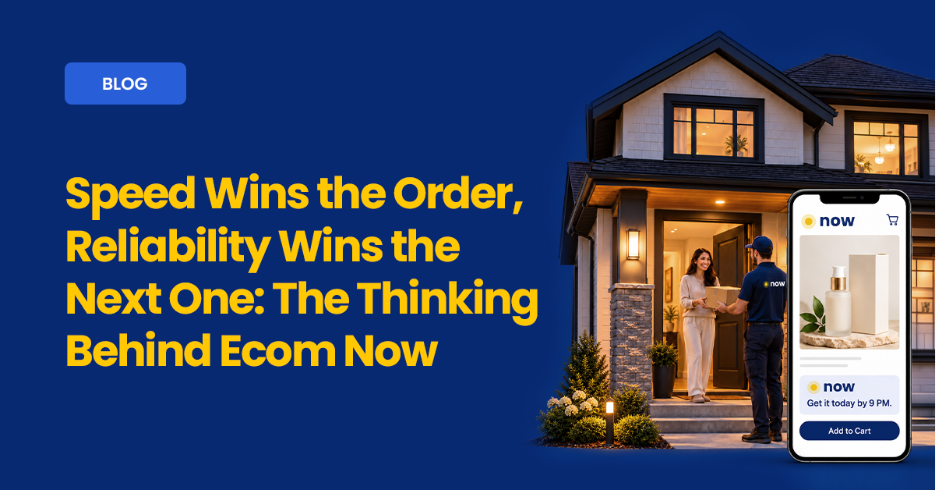
Ecom Now is our answer to every question above. It brings same-day delivery to eligible products on a brand’s own Shopify store, powered by Ecom’s connected fulfillment and delivery network.
The promise is simple: order eligible products before noon, and they’re delivered the same day by 9 PM.
From click to doorstep
- Before checkout: a NOW badge flags eligible products on the product page and in the cart, so shoppers see the promise while they are still deciding
- At checkout: an Ecom Now option spells out the delivery promise before the customer pays
- Same day: Ecom prioritizes the order for pick and pack, then routes it for delivery
- By 9 PM: the order arrives, tracked the whole way
Orders placed after the cut-off are still fulfilled and delivered the next day.
What you control, and what Ecom handles
| You control | Ecom handles |
| Which products qualify, by SKU, collection, product type or promotional period | Priority pick and pack for every Ecom Now order |
| Where you start and how fast you expand | Delivery by 9 PM in eligible zones |
| Your brand, your storefront, your customer relationship | Tracking and delivery support |
Ecom Now sits alongside your existing delivery options. There’s no new dashboard to learn and no separate courier relationship to manage. Setup happens on a call with our team, where we configure your eligible products, confirm delivery zones, activate the badge and checkout option, and run a test order before you go live.
What to know before you start
- Eligible inventory needs to be at Ecom ahead of the cut-off so it can be picked, packed and delivered the same day
- Ecom Now is live in eligible delivery zones, with coverage expanding as the service grows
- If a cart mixes eligible and non-eligible items, the same-day option isn’t offered on that order, and everything ships through your standard delivery options
Built around what the research says
Each part of Ecom Now answers a finding from this piece:
| The research shows | How Ecom Now responds |
| Slow delivery drives shoppers away at checkout | The NOW badge shows the same-day promise on the product page, before checkout |
| Most orders don’t need same-day, but some can’t wait | Brands choose which products qualify, and same-day sits beside standard options |
| On-time matters more than speed | One clear cut-off, one clear delivery window and eligibility checks before payment |
| Fewer handoffs protect the promise | One connected network handles each order from shelf to your customer’s door |
| Marketplaces are setting the pace | Shoppers get same-day on your storefront, under your brand |
With Ecom Now Every Delivery Is a Pitch for the Next Sale
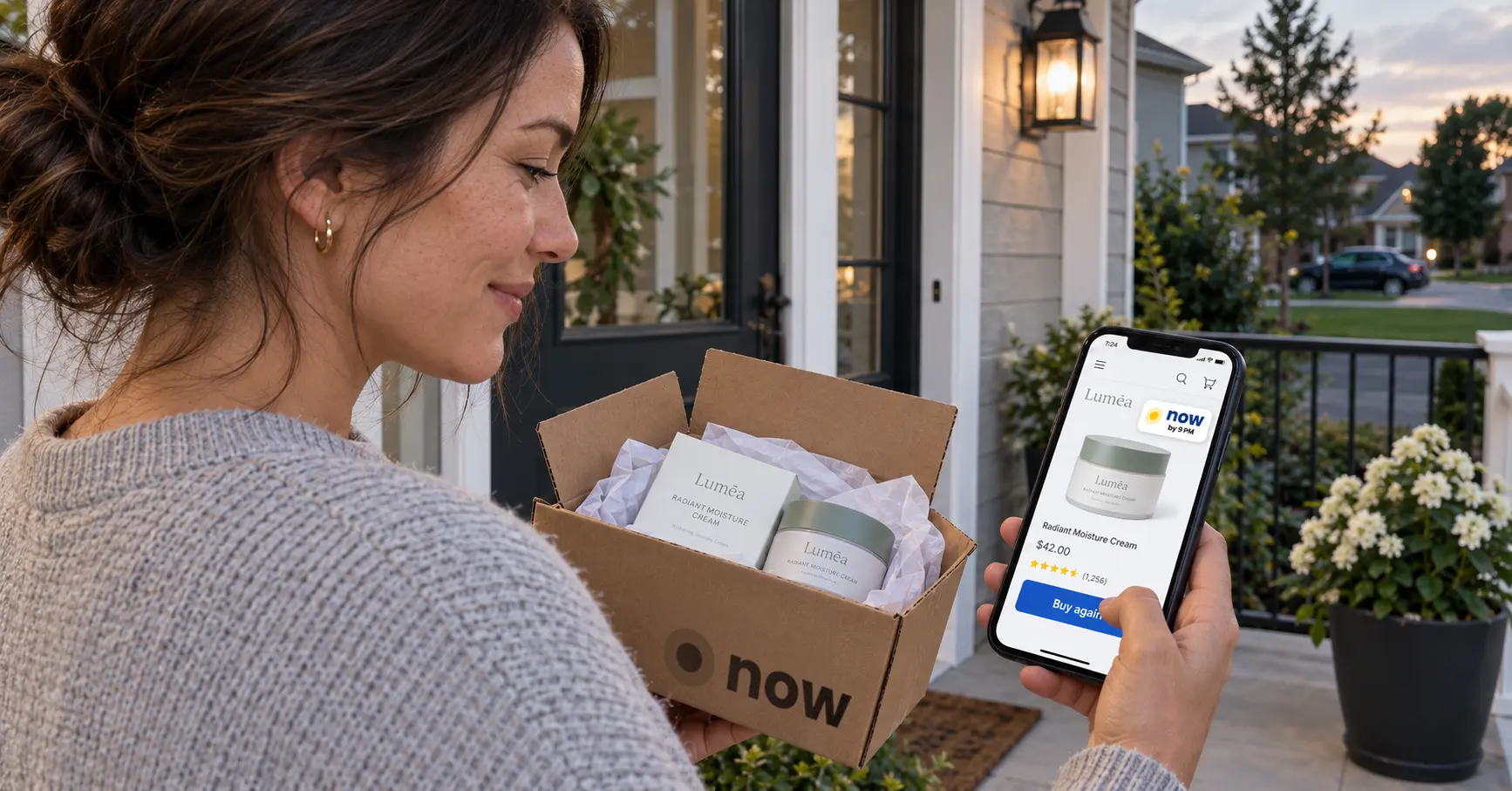
Ecommerce competition is usually framed around price, product and promotion. Those still matter. But the research keeps pointing to the stretch between “buy” and “delivered” as the place where many brands win or lose.
Customers don’t experience fulfillment and last-mile delivery as separate functions. They experience a single promise made by your brand. That promise shapes whether they buy, how they feel about the purchase, and whether they come back.
Speed can win the order. A promise kept, order after order, is what turns a first-time buyer into a loyal customer.
Sometimes the difference between a product someone wants and a product someone buys is knowing they can have it today.
If some of your products are the kind customers would happily buy today, let’s figure out which ones to start with.
Talk to an Ecom Now Expert
Frequently Asked Questions
1. Does same-day delivery increase ecommerce sales?
The evidence says faster delivery does lift sales. A 2023 peer-reviewed study in Manufacturing & Service Operations Management found that cutting delivery from three days to two raised average daily seller sales by 13.3%. In 2026, Amazon told its sellers that products with sub-same-day delivery saw 12% higher sales on average than standard delivery.
2. Why do shoppers abandon checkout over delivery?
Shoppers weigh the whole offer, including how fast an order will arrive and what delivery costs. Baymard Institute research found that 20% of shoppers who abandoned a checkout did so because delivery was too slow. 40% left because extra costs, including shipping, were too high.
3. Is on-time delivery more important than fast delivery?
For most shoppers, yes. McKinsey’s 2025 survey of more than 1,000 US consumers found that people rank on-time delivery above speed. Many would rather wait up to a week for an order that arrives as promised than get one that arrives later than expected. A same-day promise only builds loyalty when it is kept.
4. Should every product be offered with same-day delivery?
No. McKinsey found that about 90% of shoppers are happy to wait two or three days, especially to avoid shipping costs. Same-day delivery works best for high-intent, time-sensitive purchases like gifts, replacements and last-minute needs. Brands get the most value when they offer same-day on selected products, alongside standard and next-day delivery.
5. How can a Shopify store offer same-day delivery?
A Shopify store needs four things to offer same-day delivery:
- Inventory held close to customers
- A clear order cut-off
- Eligibility checks before checkout
- A fulfillment and delivery partner that can prioritize same-day orders and track them to the door
Ecom Now provides all of this for eligible products. Orders placed before noon are delivered the same day by 9 PM.
6. What is Ecom Now?
Ecom Now is a same-day delivery service from Ecom for brands selling on Shopify. Eligible products show a NOW badge on the product page and in the cart. Orders placed before noon are delivered the same day by 9 PM. Brands choose which products qualify, and Ecom handles priority pick and pack, delivery and tracking.